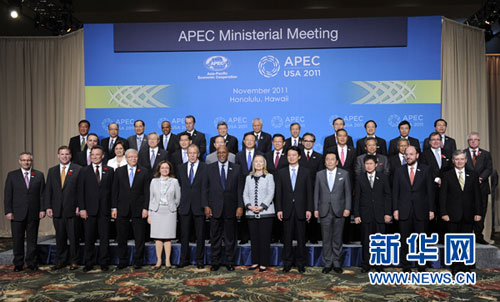
On November 11, 2011, Foreign Minister Yang Jiechi and Minister of Commerce Chen Deming attended the 23rd APEC Ministerial Meeting in Honolulu, Hawaii, the US and delivered speeches elaborating the position and propositions of the Chinese government on related issues.
Concerning Asia-Pacific cooperation, Yang said that Asia-Pacific, with the fastest and most dynamic economic growth in the world, enjoys ever rising influence and has become a major driving force for global development. The in-depth influence of the global financial crisis still lingers, economic growth in Asia-Pacific and the world at large faces severe challenges, various forms of protectionism emerge one after another and therefore it is especially imperative to strengthen regional cooperation, especially economic and trade cooperation. China believes that regional economic cooperation should be equal and inclusive, open and fair and insist on sustainable development and mutual benefit.
He noted that to deepen Asia-Pacific economic cooperation not only benefits the region but also promotes world development and prosperity. From now on, we should work to strengthen the development of multilateral trade system, push the Doha Round to make early harvest for least developed countries on the basis of respecting the mandate and locking existing results and create conditions for the completion of the negotiations to promote the sustainable growth of Asia-Pacific and world economy. Asia-Pacific free trade area should be promoted following the step-by-step principle and on the basis of 10+3, 10+6 and the Trans-Pacific Strategic Economic Partnership Agreement and Asia-Pacific economic integration should be achieved gradually. Efforts should be made to develop green economy and cultivate new growth points, implement development strategies beneficial to full employment and make the development achievements benefit all the regions and people. An innovation friendly environment should be created to shift the focus to innovation-driven growth. Cooperation in the key areas of economic restructuring should be reinforced and economic growth modal should be changed. Developed member should implement responsible macroeconomic policy and properly handle sovereign debt and financial and fiscal risks. Emerging markets should actively expand domestic demand and stimulate economic growth through consumption, investment and export simultaneously. Yang noted that China is willing to work with other countries to promote the development of APEC cooperation and make greater contributions to accelerating the economic and social progress and improving people's livelihood in Asia-Pacific.
On the support for multilateral trade system and opposition to protectionism, Chen said that it is the consistent tradition of APEC to support multilateral trade system and resist trade protectionism. The Doha Round has been going for 10 years and APEC has cheered for the negotiations for 10 years. The world economy faces many uncertain and unstable factors and the Doha Round is in a very difficult period. All the WTO members, including APEC economies should strengthen confidence in the multilateral trade system and send out positive signals for the stability and growth of world economy. The Doha Round should adhere to the established purpose and shall not deviate from the development goal. The Doha development mandate should be observed and the outcomes of negotiations over the past 10 years shall not be given up. Mutual understanding and accommodation should be made on the basis of consolidating existing outcomes and differences should be narrowed until agreement is ultimately reached. The difficulty of Doha Round is not caused by the method of negotiation but by the financial crisis which impacted all the WTO members. Members who should have been able to make contributions to the Doha Round find it difficult to make compromises. For instance, the "double exemptions" treatment which the least developed members have waited for 10 years is still not materialized. The WTO members should take a long-term perspective and make some compromises so as to boost the Doha Round. China supports Russia to join the WTO and expects the upcoming 8th Ministerial Meeting of the WTO to achieve progress.
Chen pointed out that protectionism has started rising since the Yokohama Conference and China has seriously suffered from protectionism. From January to September 2011, China has encountered 50 trade remedy investigations involving a total amount of 3 billion US dollars. He appealed to all the parties to keep high alert, take real actions to resist and eliminate various forms of protectionism and make less and cautious use of trade remedy measures. He appealed not to abuse such measures and politicize economic and trade issues. Once protectionism gets prevalent, shadow will be casted over Asia-Pacific economic cooperation and the world economy will become worse.
Talking about improving the capacity of disaster prevention and reduction, Yang said that Asia-Pacific has suffered frequent natural disasters which caused huge losses of life and property in recent years. We should step up cooperation, try to enhance capacity of disaster prevention, reduction and management and mitigate the impact of natural disasters on people's life and property and regional economy. We should strengthen education and exercises and increase the awareness and ability of citizens of disaster prevention and reduction and step up capacity building to improve the overall capacity of disaster prevention and alleviation of APEC. The Chinese government attaches great importance to disaster prevention, reduction and management and takes an active part in the international cooperation. We are willing to share experience with APEC members to push forward Asia-Pacific disaster prevention and reduction cooperation, mitigate the losses caused by disasters and make active efforts to maintain the safety of life and property of people in the region and protect regional trade and investment activities.
With regard to open governance, Yang said that APEC has taken tangible actions of promoting sound governance and anti-corruption cooperation in recent years. APEC members should continue to follow the principles of equality and mutual benefit, respecting differences and focusing on substantial results, intensify the efforts of open administration and advocate the principle of openness and transparency; step up capacity building and deepen pragmatic cooperation; renovate the governance mode to serve economic growth. The Chinese government gives priority to anti-corruption and its efforts over years have achieved effective results which have promoted the healthy and stable economic growth. China stands ready to further strengthen exchanges and cooperation with other members, jointly push forward APEC's anti-corruption and sound governance cooperation and play an active part to raise the competitiveness and boost the economy of the region.
Concerning the "next-generation" trade and investment issues, Chen noted that China holds an open attitude towards related discussions. But cooperation should respect the differences of members and meanwhile the obligation of achieving Bogor Goals shall not be undermined or replaced. In particular, as the Bogor Goals are not totally achieved as scheduled, the principle and direction of Bogor Goals must be adhered and continued efforts should be taken to promote the liberalization and facilitation of trade and investment in the region. While cooperating on innovation policies, members should focus on pragmatic cooperation, capacity building and boosting development. The concerns of developing members should be taken good care of and the development capacity and policy room should not be limited. Joint efforts should be made to develop practical technological innovation system and jointly build an enabling environment for innovation. Technology transfer and cooperation should be boosted and discriminative high-tech export policy should be revoked so that innovation results can benefit all the economies.
Regard to liberalization of environmental goods and services, Chen stressed that China fully respects the nature of APEC as a non-binding forum and holds a supportive and open attitude towards liberalization of environmental goods and services. The different economic levels and technological capacity of economies should be taken into full account to push forward the liberalization of environmental goods. Not only developing members but also developed ones should make contributions. Otherwise the principle of "common but differentiated responsibilities" will be violated. APEC should actively promote the spread of and cooperation on environmental technologies, help its members to enhance the ability to develop the environmental industry and achieve positive benefits of environment, trade and development at the same time. Some members, while promoting the liberalization of environmental goods and services, abuse trade remedy on environmental goods and unscrupulously engage in protectionism, which goes against APEC's vision of green growth. According to China's "12th five-year" plan, the percentage of non-fossil fuels, like hydraulic, wind and solar power to primary energy consumption will reach 11.4% by 2015, unit GDP energy consumption and CO2 emission will decrease by 16% and 17% respectively. Therefore, China's environmental protection industry will grow rapidly and expects to generate more than RMB2 trillion of total output value by 2015. Investment in environmental protection between 2011 and 2015 will exceed RMB3 trillion. In the process of green development, China will create significant trade and investment opportunities for businesses in the region.
During the meeting, Yang held talks with Australian Foreign Minister Rudd, Chilean Foreign Minister Moreno, Mexican Foreign Minister Espinosa, New Zealand Foreign Minister McCully and Canadian Foreign Minister Baird on the bilateral relations and the regional and international issues of common concern. Chen met with the US Trade Representative Kirk, President of the US Chamber of Commerce Donohue, Canadian International Trade Minister Fast, Indonesian Trade Minister, US Washington State Republican Congressman McDermott, Thai Deputy Prime Minister and Minister of Commerce Kittirat Na Ranong and US Secretary of Commerce Bryson respectively.