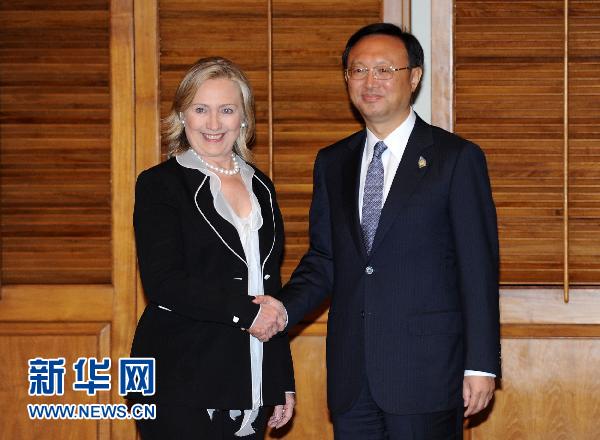
On July 22, 2011, Foreign Minister Yang Jiechi met with U.S. Secretary of State Hilary Clinton during his attendance of the series of foreign ministers' meetings of ASEAN Regional Forum in Bali, Indonesia.
Yang said President Hu Jintao paid a successful state visit to the United States in January, 2011. During the visit, President Hu reached a wide range of important consensus with President Obama, which identified the direction for China-U.S. relations in the new era. The two sides had successfully held the Strategic and Economic Dialogue and China-U.S High-Level Consultation on People-to-People Exchange. The two countries should earnestly maintain and actively promote China-U.S. relations for it is in line with the interests of both countries and the expectations of the international community. China hopes the U.S. could abide by the principles, particularly such important principles as mutual respect, equality and mutual benefit, and non-interference in each other’s internal affairs, which are identified in the three joint communiqués and China-US Joint Statement, and properly handle major sensitive issues so as to ensure the healthy and stable development of China-U.S. relations. Yang again expressed China's solemn position against the arrangement for the meeting between U.S. leaders and the Dalai Lama.
Yang said China and the United States are major countries in the Asia-Pacific. China is willing to work with the United States and other countries in the Asia-Pacific to strengthen dialogue, enhance mutual trust, develop cooperation and jointly safeguard and promote regional peace, stability and prosperity.
With respect to the South China Sea issues, Yang said China and ASEAN countries have just passed the action guidelines for the implementation of the Declaration on the Conduct of Parties in the South China Sea, which has not only paved the way for the pragmatic cooperation in the South China Sea, but also proved that China and ASEAN countries have the ability and wisdom to resolve the dispute. Yang pointed out the freedom of navigation and security in the South China Sea is not under threat. China is always committed to maintaining the freedom of navigation and security in the South China Sea.
Clinton said President Hu Jintao’s visit to the United States has promoted the development of bilateral relations. The United States is committed to continuing to drive this good momentum. She said the U.S. understands the sensitivity of Tibet, Taiwan and other issues. The U.S. would like to reaffirm the consistent position of adhering to one-China policy and respecting China's sovereignty and territorial integrity. The two sides agreed to expand cooperation and reduce differences from the perspective of safeguarding the overall situation of bilateral relations. The two sides also agreed to enhance communication on issues, which are concerns to the other side.
Clinton spoke highly of the agreement between China and ASEAN countries on the action guidelines for the implementation of the Declaration on the Conduct of Parties in the South China Sea. Clinton said the United States understands the extreme complexity of the South China Sea issues. The U.S. does not hold a position on the dispute over the sovereignty in the South China Sea. The U.S. has no intention to get involved or make it an issue between China and the United States. The U.S. supports measures conducive to easing the situation.
With respect to carrying out multilateral cooperation projects in specific areas in the Asia Pacific region, the two sides reached consensus in principle on carrying out cooperation in such areas as food security, urban search and rescue, and disaster relief capacity-building on the basis of full respect for the views of other interested parties in the Asia-Pacific.
The two sides also exchanged views on other topics such as the East Asia Summit, the situation on the Korean Peninsula, and the situation in South Asia.